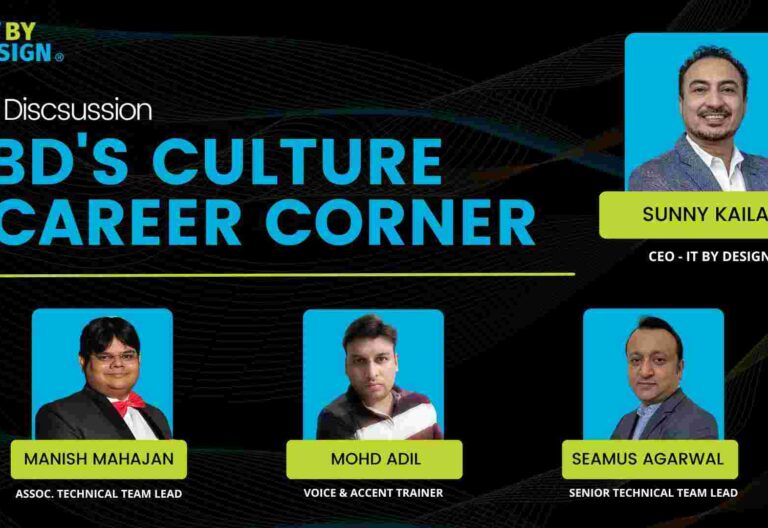
I listened to the latest Culture and Career Corner episodes twice before I sat down to write this. Not because I was looking for something. Because Anamika’s conversations with Neeraj and Andrea gave me two very different stories that landed on the exact same point.
That point is this: culture is not what we say in a deck. It’s what people choose to come back to, and what they choose to notice when no one is measuring it.
The Second Innings
Neeraj joined ITBD in 2015 as a system engineer. We were around 60 people then. He left, and in 2024, Anamika called him with an opening for a TL role. He said yes.
Here’s what stayed with me. When Anamika asked him to describe his aha moments, the first thing he mentioned wasn’t a project or a promotion. It was me walking up to his desk, shaking his hand, and asking about his health, his family, and his work, in that order.
I don’t remember every one of those conversations. I have a lot of them. But Neeraj remembered his. That’s the gap between how leadership feels from the inside and how it lands on the other side of the desk. You don’t always know which five-minute conversation becomes someone’s defining memory of the company.
He called joining ITBD a second time “like returning home.” That phrase is doing real work. Home isn’t a place you’re loyal to out of obligation. It’s a place you go back to because it’s still standing the way you left it, or because it grew into something better while you were gone. Neeraj came back to a team of 850 plus. He came back to old colleagues who had grown into new roles. The company changed. What didn’t change was the reason he wanted to be part of it.
The Golden Temple and the Golden Rule
Andrea joined more recently, coming from a different organization. She said something plain and direct about that transition: it was a breath of fresh air she didn’t know she needed. Not because the work was easier. Because, in her words, most companies focus on the dollar, and ITBD invests in the individual.
That’s not a tagline I gave her. That’s her read on it, unprompted.
Andrea traveled to India for a leadership summit and described it as an experience she wouldn’t forget, challenges included. She visited the Golden Temple, and what struck her wasn’t the architecture. It was the intention behind it. A place built to feed people, sustaining that purpose long after the people who built it were gone. She connected that directly to leadership: legacy isn’t the plaque, it’s whether the thing you built still does what it was built to do.
Her biggest takeaway from those five days was leading with intentionality. Her reasoning was practical, not sentimental. If you want your employees taken care of, you have to invest in the leaders above them, because managing down is easier than managing sideways or up. Put the right leader in place, and the care travels downhill on its own.
Ownership Looks Different at Every Desk
Neeraj described ownership in a way I want every team lead to hear. He said when he’s stuck on something technical, he walks the floor and finds whoever knows SQL or Exchange better than he does, and they help him without hesitation. He called it a shared kind of ownership: the primary owner does the work, but the people around him take on enough of the problem to make sure it gets solved.
Andrea’s version of the same idea showed up in how she talked about one-on-ones. She and Anamika both pushed back on the transactional model, the one-on-one that only asks about targets and misses that someone might be struggling with something outside of work. Andrea’s phrase was that leaders need to be relatable, and that showing up as a person first is how trust actually gets built.
Different roles, different offices, same instinct. Take care of the person, and the output takes care of itself.
What This Means If You Run an MSP
I’m not writing this to celebrate two great employees, although they are. I’m writing this because both conversations point to something operational.
Retention isn’t a benefits conversation. Neeraj didn’t come back for a better title. He came back because the relationships were still there and the mission still made sense to him. If your best people are leaving and your exit interviews all mention money, look again. Money is rarely the whole story. Sometimes it’s the only reason people feel safe giving you.
Culture shows up in the small, unscaled moments. I didn’t schedule those desk conversations with Neeraj as a retention strategy. I did them because I wanted to know how he was doing. The fact that it became his top memory of the company tells me those unscaled, un-metriced moments might matter more than the programs we build around them.
Leadership investment isn’t a nice-to-have. Andrea’s argument was blunt: you can’t expect frontline employees to feel supported if the leaders above them were never taught how to support anyone. If you’re only investing in your individual contributors and skipping the leadership layer, you’re building a leaky pipe and wondering why the water pressure is low at the end of it.
Where I Land
Both Neeraj and Andrea used almost the same word, without planning to. Neeraj called it feeling valued. Andrea called it being invested in. Underneath both is the same idea: people can tell the difference between a company that wants their output and a company that wants them to grow.
That’s the culture I’m trying to build here, not the one on the wall, the one in the desk conversations and the leadership trips and the moments nobody scores. Neeraj and Andrea gave language to something I feel but don’t always articulate well. I’m grateful for that, and I think our listeners will be too.
If today’s episode resonated with you, there are more of these stories coming. Culture and Career Corner exists because the people living the culture usually explain it better than the person who started it.